

Organizing instruments in a school music room can feel like solving a puzzle—one that grows more complex as your program expands. Teachers often debate whether to install musical instrument lockers or go with more flexible mobile instrument carts. Both options have their place, but understanding their differences is key to finding what works best for your orchestra, concert band, marching band, or ensemble.
What Makes Musical Instrument Lockers and Cubbies Popular?
School instrument lockers offer you a clean, structured solution. They’re usually custom-built for the space, often reaching wall-to-wall and floor-to-ceiling. They’re popular for their ability to manage high traffic and provide long-term, stable housing for your students’ instruments. Because they’re built into the facility, musical instrument lockers are often treated as a long-term capital project, sometimes tied to a bond issue or major building upgrade rather than a quick, in-year purchase.
ADVANTAGES INCLUDE:
- Vertical storage power: Stackable cubbies for instruments use vertical space efficiently.
- Security: Lockers often come with built-in locks or slots for padlocks, making them trusted instrument storage lockers.
- Student accountability: Labeled lockers help track each student’s assigned instrument location.
- Longevity: Once installed, musical instrument storage lockers typically last for decades.
- Insurance advantages: Lockers can offer more protection in theft-prone environments, which may lower insurance risk and liability for schools.

Downsides of Built-In Lockers and Cubbies
- Expensive: Installation and retrofitting carry high costs.
- Extra layers of approval: Installing new school instrument lockers often involves facilities staff, district purchasing, and sometimes board-level approval, which can slow the process compared with simply ordering mobile racks.
- Long planning and installation timelines: In addition to a drawn-out approval process, installing new school instrument lockers often stretches over multiple budget cycles, and sometimes waiting on a bond issue or renovation schedule—so they’re not a fast solution if you need storage this semester.
- Poor fit for large instruments: Bulky items like cellos, drum kits, and double basses often don’t fit.
- Inaccessible for young students: Middle schoolers may struggle to reach top lockers safely.
- Permanently fixed: Lockers can’t move when:
- Your room is reassigned for state testing, voting, or assemblies.
- Construction shuts down the music wing temporarily.
- Your enrollment grows and you need more orchestra or band instrument lockers.
- Challenging to expand: Adding new lockers later isn’t always possible or affordable.
- Not practical for instrument sharing: Programs with shared gear between periods struggle with locker-based storage.

The Rising Popularity of Mobile Instrument Storage Carts
As more schools look for affordable, flexible solutions, mobile carts from BandStorage.com are becoming a top choice. With stringed-instrument options like cello storage carts and violin racks, and solutions for brass instruments too like racks for trumpet cases, and >trombone storage too, there’s something for every section in your band or orchestra.
Unlike locker systems that may take months or even years to plan and fund, mobile racks can typically be ordered, shipped, and set up in about one to two weeks—so you get relief right away.
KEY FEATURES:
- Easy access for all students: No reaching or climbing—just grab and go.
- Accessible for students with physical limitations: Mobile carts provide inclusive access without needing step stools or staff assistance.
- Ready for change: Move carts between classrooms, stages, or storage areas with ease. Especially helpful during:
- Room reassignments for testing, elections, or emergencies
- Renovation projects
- School-wide events or assemblies
- Day-to-day flexibility when ensembles rotate through a single room
- Transporting instruments to off-campus concerts, festivals, or parades
- Budget-smart: Carts cost far less than band lockers, don’t require permanent alterations to the classroom, and usually don’t need the same level of facilities or board approval that locker installations do.
- Fast setup: Most racks are classroom-ready in a half hour to an hour.
- Expandable: Easily add new racks as your program grows.
- Great for shared equipment: Switch between uses and ensembles without hassle.
- Quick visual checks: Instantly see which instruments are stored and which are missing.
- Seasonal efficiency: Carts can be wheeled into secure closets or storage rooms during summer or off-season months to free up classroom space.
- Supports shared room usage: Mobile racks make it easier to transition between orchestra, band, and choir groups that share the same room.

Limitations of Mobile Storage Carts
- Security limitations: While great in a locked room, carts don’t offer the personal security of individual instrument lockers.
- Risk of damage if rolled carelessly: If students or staff push carts too fast, bump into door frames, or hit uneven thresholds, instruments can shake, shift, or be jostled more than they would in fixed lockers.
- More visible, less “out of the way”: Because carts live out on the floor instead of built into walls, they can make a room feel crowded if not positioned thoughtfully. Teachers need to be intentional about where they park them.
- Require clear expectations for student use: Unlike lockers that are fixed and individually assigned, carts may be shared. Without clear routines, students might return instruments to the wrong spot or crowd around the cart at once.
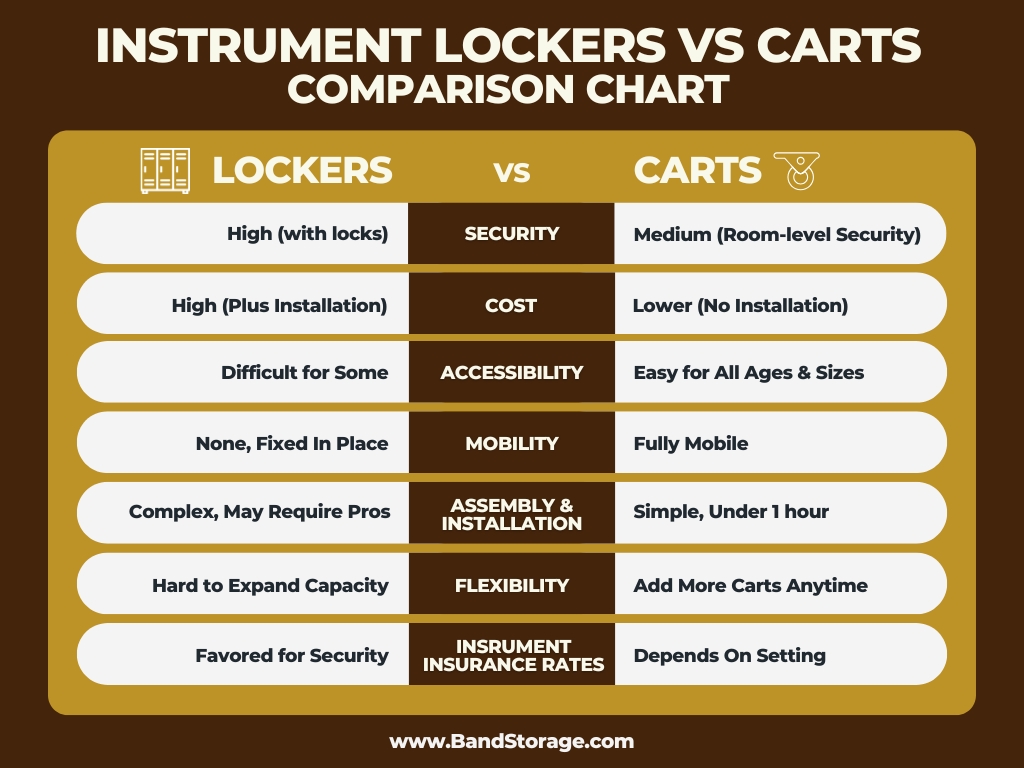
Locker vs Cart Comparison Chart
Which Solution Should You Choose?
If you have a permanent, dedicated classroom with plenty of funding—and the time to move through facilities and district approvals—musical instrument lockers or a custom musical instrument cabinet may serve your needs. If you need inexpensive storage now, mobile storage carts can typically be delivered and assembled within a week or two, giving you an immediate, flexible solution while larger capital projects work their way through the bond or renovation process.
Whether you’re directing a growing orchestra, a busy marching band, or a rotating ensemble schedule, the right storage solution depends on how you teach, move, and grow. Consider your classroom’s layout, your program’s goals, and your students’ needs—and choose the system that helps you stay organized, responsive, and prepared.